US V UK Real Estate Buying Process
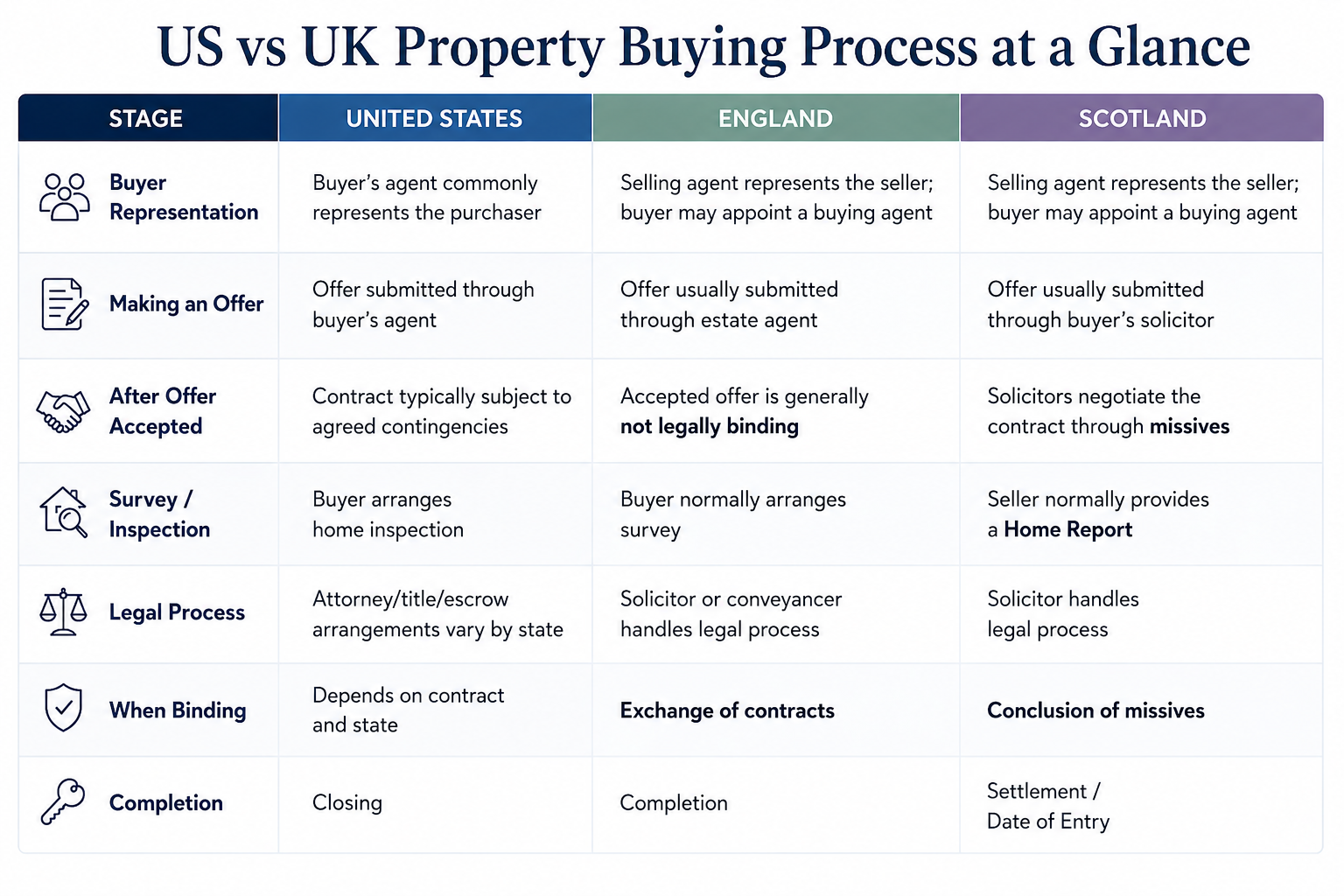
What American Buyers Need to Know
For American buyers looking to purchase a home, investment property or country estate in the UK, the buying process can initially appear very familiar. You find a property, make an offer, undertake due diligence and complete the purchase.
However, there are some significant differences between the US and UK systems. There are also important differences between buying property in England and Scotland.
Understanding these differences before beginning your search can make purchasing UK real estate considerably easier.
The Role of the Buyer's Agent
One of the biggest differences is how estate agents operate.
In the US, buyers commonly have their own real estate agent representing their interests throughout the transaction. The buyer's agent helps identify suitable properties, advises on value, negotiates the purchase and assists the client through the closing process.
In the UK, the estate agent marketing a property represents the seller.
While the selling agent can provide information and facilitate viewings, their primary responsibility is to their client—the property owner.
For international buyers, particularly those purchasing remotely, this is why appointing an independent buying advisor can be particularly valuable. A buying advisor represents the purchaser, searches the wider market, provides independent advice on value, negotiates on their behalf and coordinates the professionals involved in the transaction.
Making an Offer in England
The English buying process contains one distinction that can surprise American buyers.
When an offer is accepted on a property in England, the transaction is not normally legally binding at that point.
For example, a London property may be marketed at £3 million. A buyer offers £2.8 million and the seller accepts.
Although the property may subsequently be described as "under offer", the transaction does not become legally binding until contracts are exchanged.
Between acceptance of the offer and exchange of contracts, the buyer's solicitor carries out legal due diligence, searches are undertaken, financing is finalised where required and the buyer may commission a building survey.
Until exchange, either party can generally withdraw from the transaction.
Surveys and Inspections
American buyers will be familiar with arranging a home inspection after agreeing a purchase.
In England, buyers can commission different levels of survey depending upon the age, condition and complexity of the property.
For prime, historic or country properties, a comprehensive building survey will often be advisable. Additional specialists may also be required to investigate issues such as roofing, drainage, structural movement or listed-building considerations.
The buyer's solicitor separately investigates the legal title and other matters affecting the property.
Exchange and Completion
Once the buyer and seller are satisfied with the contract and the necessary legal work has been completed, contracts are exchanged.
Exchange of contracts is the point at which the transaction becomes legally binding.
A completion date is agreed and, on completion, the balance of the purchase price is transferred to the seller. Ownership passes to the buyer and the keys are released.
This is broadly equivalent to the American concept of closing, although the mechanics are different.
Buying Property in Scotland
Scotland has its own legal system and the residential property buying process differs considerably from England.
One of the most noticeable differences is the Home Report.
Most residential properties marketed for sale in Scotland require a Home Report prepared for the seller. This normally includes a survey and valuation, an Energy Performance Certificate and a property questionnaire.
This gives prospective buyers considerably more information about the property before making an offer.
Offers Over and Closing Dates
Scottish properties are frequently marketed using an "Offers Over" price.
American buyers should not assume this represents the property's market value.
For example, a property could be marketed at Offers Over £1 million, have a Home Report valuation of £1.1 million and ultimately sell for £1.2 million.
In competitive markets such as Edinburgh and parts of Scotland's prime country and coastal market, buyers may submit a Note of Interest through their solicitor.
Where several buyers are interested, the seller may set a closing date, at which interested parties submit their best offers.
Understanding the relationship between asking price, Home Report valuation and likely selling price is therefore particularly important.
When Does a Scottish Purchase Become Binding?
Offers in Scotland are generally handled through solicitors.
Following acceptance of an offer, the buyer's and seller's solicitors negotiate the detailed terms through a series of formal communications known as missives.
Once the missives are concluded, the contract is legally binding.
The transaction then proceeds towards the agreed date of entry, when the purchase funds are transferred and the buyer takes ownership of the property.
Having Someone on Your Side
For an American buyer, purchasing UK real estate does not need to be complicated. The key is understanding that the system operates differently and ensuring that the right professionals are representing your interests.
An experienced buying advisor can act as a single point of contact throughout the acquisition, from establishing the initial search brief and identifying on- and off-market opportunities through to valuation, negotiation and completion.
They can also coordinate estate agents, solicitors, surveyors, bankers and other specialists, helping an overseas buyer navigate a process that may otherwise feel unfamiliar.
For US buyers seeking exceptional real estate in the UK, having experienced representation on the ground can make the difference between simply finding a property and securing the right one.
